
In wholesale power trading, the edge often goes to whoever understands the most information, the fastest, and gets it right. The problem is that the amount of information now far exceeds what any team of analysts can read.
Mike Taylor, our co-founder for strategy, analytics, and operations, spent nearly two decades building quantitative strategies and analytics in U.S. wholesale power markets. This case study describes how we applied AI to that world: not to make trading decisions, but to read and cross-check far more data than people can, prove where every number came from, and put a verified picture in front of the people who do make the decisions.
The challenge: too much data, too little time
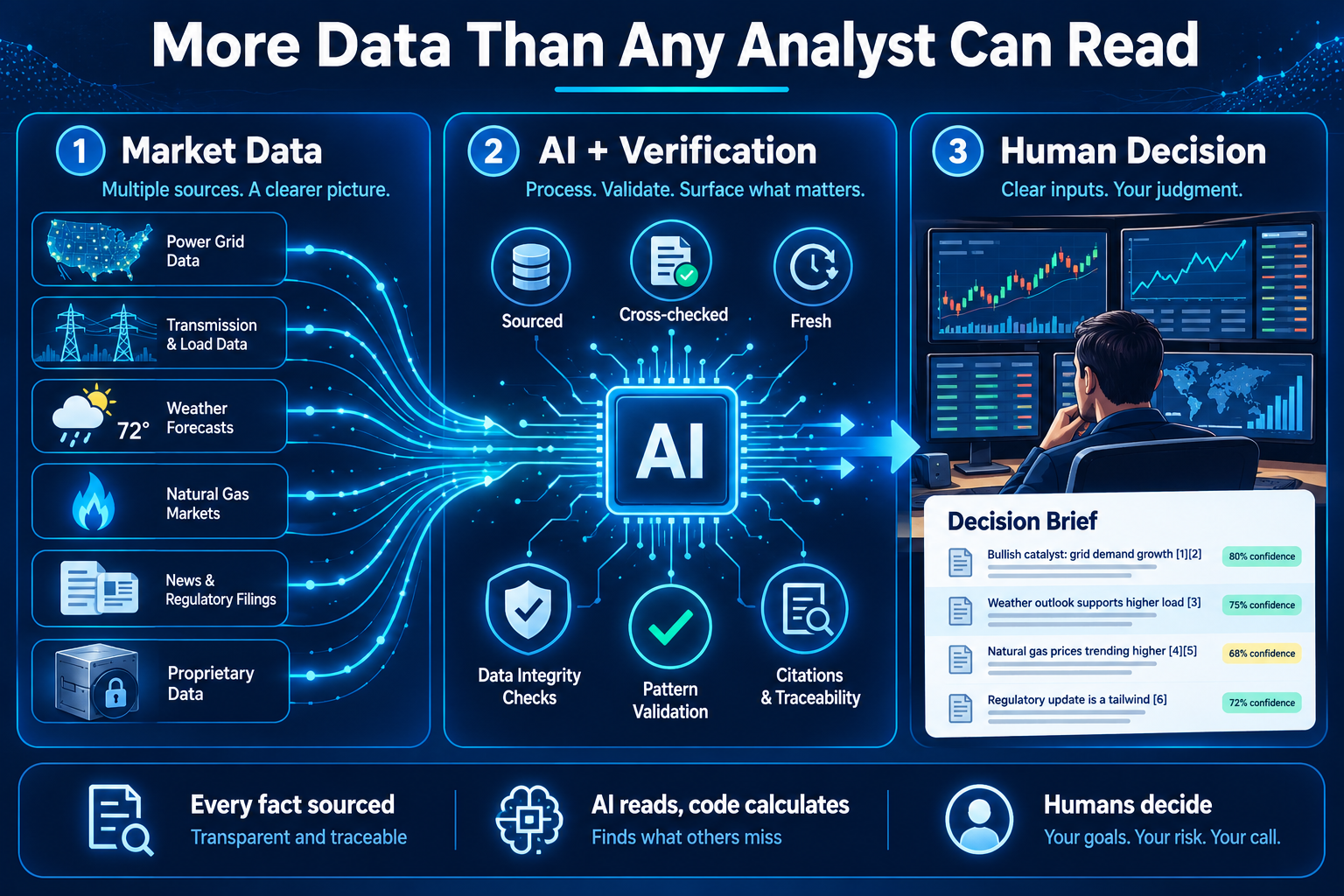
Power prices move with the weather, the grid, fuel markets, and the rules. On any given day, a trading desk may need to account for:
- Grid operator market data: day-ahead and real-time prices at hundreds of locations, load (demand) forecasts and actuals, generation mix, and reserve conditions from regional grid operators
- Outages and constraints: planned and unplanned power plant outages, transmission line work, and congestion that can split one region’s prices from another’s
- Weather: temperature forecasts that drive demand, plus wind and solar forecasts that drive renewable output, often from several forecast models that disagree
- Fuel: natural gas prices and pipeline notices, since gas-fired plants often set the price of power
- Rules and notices: market bulletins, regulatory filings, and rule changes that can quietly change how a market behaves
- The firm’s own knowledge: historical positions and results, in-house pricing and fundamental models, and years of analyst notes on what happened the last time conditions looked like this
Each source has its own format, schedule, and quirks. Some data is published and then revised. Notices arrive as long documents where the one detail that matters is buried in the fourth paragraph. Before the market opens, analysts were spending much of their time collecting and reformatting information, and still could only skim a fraction of it. What nobody had time to read was, by definition, not part of the decision.
The goal: help the human, don’t replace them
We set three ground rules at the start:
- AI never makes or places a trade. It prepares information. Traders and risk managers decide.
- No source, no claim. Every number and every statement shown to a trader must link back to where it came from and when.
- Trust is earned through checks. In trading, a wrong number costs real money, so the system has to show its work and flag its own uncertainty.
How it works
1. Bring the feeds together
Structured feeds (prices, load, weather, fuel, and outage data) are pulled automatically on their own schedules and converted into one consistent, time-aligned dataset: the same time zone, the same units, and the same naming for locations and assets. Unstructured sources, such as market notices, filings, and news, are collected into a searchable library. Every item is stamped with its source, the time it was published, and the time it was retrieved.
2. Verify before anything is analyzed
Before any AI touches the data, a verification layer runs a series of checks:
- Freshness: Is this feed current, or did it quietly stop updating overnight? Stale data is flagged, never silently used.
- Sanity and range checks: Values outside plausible ranges, sudden jumps, and missing intervals are flagged for review.
- Cross-source agreement: Where the same fact is available from more than one place, the sources are compared. When they disagree, both values are shown side by side rather than one being picked silently.
- Revision tracking: When a source revises earlier data, the change is recorded, so analysis always knows which version it used.
3. Let AI do the reading
This is where AI multiplies the team’s capacity. Language models read every notice, filing, and report as it arrives, which is far more than any analyst could, and:
- Extract the details that matter (which asset, which dates, how much capacity, which market) into structured form, each with a citation back to the exact passage in the source
- Summarize what changed since yesterday, instead of repeating what everyone already knows
- Connect new information to the firm’s own history and models: “the last three times a similar outage overlapped a heat wave in this region, here is what happened”
- Flag anything unusual for a human to look at
An important design choice: the AI reads and explains, but it doesn’t do the math of record. Calculations such as spreads, totals, and comparisons are done by ordinary, tested code. Language models are excellent readers and summarizers, but they are not reliable calculators, so they aren’t asked to be.
4. Check the AI, too
Because AI can state things confidently that aren’t true, its output goes through its own verification:
- Every extracted figure is checked against the source text it cites. If the passage doesn’t contain the number, the item is rejected.
- Key facts are confirmed against a second, independent source where one exists.
- Uncertain or conflicting items are labeled as such and routed to an analyst, not smoothed over.
5. Deliver a decision brief
The result is a concise brief for the trading team: what changed, why it may matter, how confident the system is, and where each fact came from, with one click back to the original source. Conflicts and data-quality warnings sit at the top, not in a footnote. Traders make the call, and their notes on what they decided and why feed back into the firm’s knowledge base for next time.
Protecting proprietary insight
A trading firm’s own data and models are its edge, so they are treated that way:
- Proprietary data stays within the firm’s controlled environment and is not used to train public AI models.
- Access is limited by role, and every brief, source, and check is logged, giving compliance and risk teams a clear record of what information was available when a decision was made.
- New AI behavior is tested against past market events with known outcomes before anyone relies on it.
The results
- Far broader coverage. Every notice and report gets read, not just the ones someone had time for.
- Faster preparation. Analysts spend their mornings interpreting information instead of collecting and reformatting it.
- Fewer surprises. Stale feeds, conflicting sources, and revised data are caught and flagged before they reach a decision.
- Traceable decisions. Every fact in a brief can be traced to its source, which builds trust with traders and makes reviews and audits straightforward.
- People focused on judgment. The experienced team spends its time where it adds the most value: weighing risk and making the call.
The lesson for any business
You don’t need to trade power for this pattern to apply. Any business that makes decisions from more information than its people can absorb, whether supplier updates, financial reports, customer data, or regulatory changes, can use the same approach:
- Bring the sources together in one consistent place.
- Verify the data before you analyze it.
- Let AI do the reading, with a citation for everything.
- Check the AI’s work, and keep the math in tested code.
- Put a clear, sourced summary in front of the people who decide.
Done this way, AI doesn’t replace expertise. It lets experienced people apply their expertise to everything that matters instead of just the part they had time to read.
Want to put your data to work?
If your team is drowning in information, or you’re not sure your decisions are using the best data you have, take a look at our business process, analytics, and operations and AI consulting services, or request a free consultation.